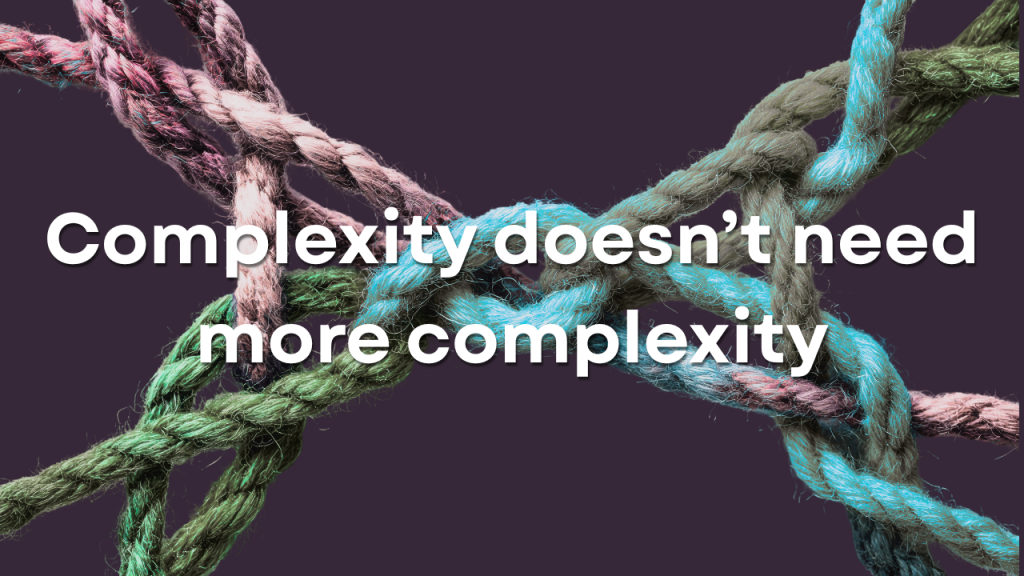
By this point, you’ve done more than most. You haven’t sat on the sidelines waiting for automation to mature before dipping a toe in. You’ve tried things. Quite a lot of things, in fact. Some of them worked, and worked well enough that they’re still running today. Others didn’t, and were quietly retired, or worse, left half finished and forgotten about in a shared drive somewhere.
The result is a familiar one. A patchwork of tools that don’t quite talk to each other. A backlog of ideas that everyone agrees are good but nobody has the bandwidth to build. And underneath it all, a nagging sense that despite all the effort and all the spend, there’s still no clear path from where you are to where you actually want to be.
If that sounds like where your business is right now, you’re not behind. You’re further along than most, and you’re facing a different problem entirely to the ones we usually write about. You don’t need convincing that automation works. You need a way to stop it sprawling.
Another pilot won’t fix this
It’s tempting, when a business reaches this stage, to greenlight one more initiative. A new pilot, a new tool, a new department taking its own run at automation because the last attempt didn’t quite land. We understand the instinct. Each individual piece of your patchwork probably started life as a perfectly reasonable response to a real, specific problem.
But that’s exactly how patchworks are made. One sensible decision at a time, made in isolation, without a shared architecture underneath holding it all together. Add another pilot to that mix and you don’t get closer to scale. You get a slightly bigger patchwork, with one more system that needs integrating, maintaining, and eventually replacing.
What you’re describing isn’t a tooling gap. It’s an architecture gap. And the way out of it isn’t another experiment. It’s a transformation programme, one that starts by asking what a unified system should look like across the whole business, rather than what the next department needs in isolation.
Why AI foundation models fit this moment
This is precisely the kind of complexity that AI foundation models were built to handle. Where a patchwork of point tools each solve one narrow problem in their own particular way, a foundation model approach gives you a single, adaptable layer of intelligence that sits across functions, understands context, and can be directed at whatever problem comes next, rather than requiring a bespoke build for each one.
That doesn’t mean throwing away everything you’ve built so far. Some of your existing systems are working well and deserve to stay. What it means is giving all of it, the parts that work and the backlog of ideas that don’t yet exist, a common architecture to sit within. One data foundation. One orchestration layer. One place where decisions get made about what to build next and why, instead of six different teams each solving their own version of the same underlying problem.
Drowning in manual, repetitive work? Tell us the task and we’ll show you what to automate.
This is also where a genuine transformation programme differs from a pilot. A pilot proves a single idea works. A transformation programme builds the architecture that makes every future idea faster, cheaper, and less risky to implement, because the foundations are already there.
You’ve already done the hard part
It’s worth pausing on this, because it’s easy to lose sight of during the frustration of a stalled backlog. Getting a business to try automation in the first place, more than once, across more than one department, is genuinely difficult. Most organisations never get past the first hesitant attempt. You have a patchwork because you kept going. That’s not a failure. It’s momentum without a map.
What you need now is the map. A clear, honest look at what’s working, what isn’t, and what a single coherent architecture would look like if it replaced the patchwork rather than adding to it.
Where to go from here
You don’t need another pilot, and you don’t need to be talked into the value of automation. You’ve already proved that to yourself several times over. What you need is a partner who can look at everything you’ve built, everything that’s still sitting in the backlog, and turn it into one architecture built to scale rather than sprawl.
Book a free discovery call with our team, and let’s work out which AI strategy genuinely fits your business, one that turns your patchwork into a foundation, and your backlog into a roadmap.